
Investing in emerging markets presents a compelling opportunity for significant returns, but also carries inherent risks. This exploration delves into the world of high-return emerging market funds, examining their investment strategies, performance metrics, and the crucial risk-reward considerations involved. We’ll analyze successful funds, explore various investment approaches, and ultimately equip you with a clearer understanding of navigating this dynamic investment landscape.
From understanding the unique characteristics of emerging economies to mastering the art of risk mitigation, we aim to provide a comprehensive overview. We will cover key performance indicators, different investment strategies, and the importance of a long-term perspective in achieving success in this potentially lucrative, yet volatile, market segment.
Defining Emerging Markets
Emerging markets represent a diverse group of nations transitioning from developing to developed economies. These economies exhibit rapid growth potential, often coupled with significant volatility and risk. They are characterized by increasing industrialization, urbanization, and integration into the global economy, but also often grapple with infrastructure challenges, political instability, and regulatory uncertainties.Emerging markets are distinguished from developed markets primarily by several key economic and political factors.
Developed markets generally boast higher per capita incomes, robust institutional frameworks, stable political systems, and well-established financial markets. In contrast, emerging markets often experience higher inflation rates, greater income inequality, less developed infrastructure, and more volatile currency values. Political risk, including corruption, weak rule of law, and potential social unrest, is also typically higher in emerging markets.
Emerging Market Classifications and Indices
Several organizations classify and track emerging markets using different methodologies. These classifications often overlap but aren’t always perfectly aligned. The MSCI Emerging Markets Index, for example, is widely used by investors to benchmark performance, but its composition differs from other indices like the FTSE Emerging Markets Index or the S&P Emerging Markets BMI. Differences in methodology stem from variations in criteria such as market capitalization, liquidity, and free-float adjustments.
These differences can lead to variations in the specific countries included in each index and their relative weightings.
| Region | Country Examples | Key Economic Indicators | Investment Risks |
|---|---|---|---|
| Latin America | Brazil, Mexico, Chile | GDP growth, inflation, foreign direct investment, current account balance | Political instability, currency volatility, commodity price fluctuations |
| Asia | China, India, Indonesia | GDP growth, export levels, foreign exchange reserves, manufacturing output | Geopolitical risks, regulatory changes, currency devaluation |
| Africa | Nigeria, South Africa, Egypt | GDP growth, infrastructure development, commodity exports, debt levels | Political instability, corruption, infrastructure deficits |
| Eastern Europe | Poland, Russia, Turkey | GDP growth, inflation, foreign investment, energy dependence | Geopolitical risks, currency volatility, economic sanctions |
Identifying High-Return Emerging Market Funds
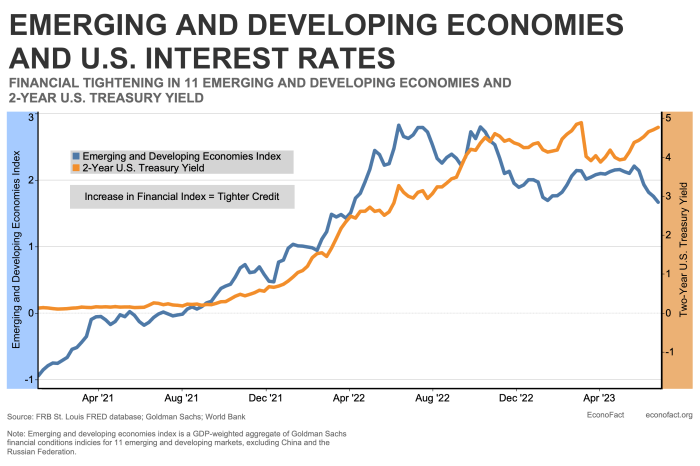
Investing in emerging markets offers the potential for significant returns, but it’s crucial to carefully select funds with a proven track record and a well-defined investment strategy. High-return emerging market funds often leverage specific approaches to navigate the unique opportunities and risks inherent in these dynamic economies. Understanding these strategies and associated risks is key to making informed investment decisions.Successful emerging market funds consistently outperform their benchmarks by employing diverse strategies and navigating market volatility effectively.
Their performance is a result of a combination of skilled management, strategic allocation, and a thorough understanding of macroeconomic trends in emerging economies. However, it’s important to acknowledge that past performance is not indicative of future results, and these investments carry inherent risks.
Examples of Successful Emerging Market Funds and Their Investment Strategies
Several funds have demonstrated a history of strong performance in the emerging markets sector. These funds often utilize different investment approaches, reflecting the diverse nature of the emerging market landscape. Understanding these approaches is essential for investors seeking to replicate success or to make informed comparisons.
- Fund Name: (Example: A hypothetical fund – “Global Emerging Markets Leaders Fund”)
Management Style: Growth-oriented, focusing on companies with strong fundamentals and high growth potential in diverse sectors. This fund actively manages its portfolio, taking advantage of short-term market fluctuations.
Historical Performance: (Example: Hypothetical 15% average annual return over the past 5 years. Note: This is a hypothetical example and should not be taken as a guarantee of future performance.) - Fund Name: (Example: Another hypothetical fund – “Emerging Markets Value Equity Fund”)
Management Style: Value investing approach, seeking undervalued companies with strong long-term prospects. This fund tends to hold investments for longer periods, focusing on fundamental analysis rather than short-term market timing.
Historical Performance: (Example: Hypothetical 12% average annual return over the past 10 years. Note: This is a hypothetical example and should not be taken as a guarantee of future performance.) - Fund Name: (Example: A hypothetical fund – “Frontier Markets Opportunities Fund”)
Management Style: Concentrated portfolio focused on frontier markets (countries with less developed capital markets than emerging markets), seeking higher growth potential but with increased risk.
Historical Performance: (Example: Hypothetical 18% average annual return over the past 7 years, with higher volatility. Note: This is a hypothetical example and should not be taken as a guarantee of future performance.)
Risk Factors Associated with High-Return Emerging Market Funds
Investing in emerging markets inherently carries higher risk compared to developed markets. These risks are often amplified in funds targeting high returns. A thorough understanding of these risks is critical for prudent investment decisions.While the potential for high returns is attractive, investors must be aware of several key risk factors:
- Currency Fluctuations: Changes in exchange rates can significantly impact returns, especially for funds with significant exposure to multiple currencies.
- Political and Economic Instability: Emerging markets are often subject to political instability and economic volatility, which can lead to sudden market downturns.
- Regulatory Uncertainty: Changes in regulations and government policies can affect the performance of companies and the overall market.
- Liquidity Risk: Some emerging markets have less liquid markets, making it harder to buy or sell investments quickly.
- Country-Specific Risks: Each emerging market presents its own unique risks, including corruption, social unrest, and natural disasters.
Analyzing Investment Strategies
Understanding the diverse investment approaches employed by emerging market funds is crucial for investors seeking to navigate the complexities and potential rewards of these markets. Different strategies cater to varying risk appetites and market outlooks, leading to diverse performance profiles across different economic cycles.
Emerging market funds utilize a range of investment strategies, broadly categorized as passive, active, and thematic. Passive strategies, such as index funds, aim to replicate the performance of a specific emerging market benchmark index. Active management, on the other hand, involves fund managers actively selecting individual securities based on their research and market analysis, aiming to outperform the benchmark.
Thematic investing focuses on specific sectors or trends within emerging markets, such as technology, renewable energy, or consumer goods, believing these areas offer superior growth potential.
Passive versus Active Management Performance
Passive management generally entails lower fees compared to active management, making it attractive for long-term investors. However, active managers believe their expertise in identifying undervalued securities and navigating market complexities can lead to superior returns. Historical performance comparisons between passive and active emerging market funds show mixed results, varying across market cycles. During periods of sustained market growth, both strategies often deliver positive returns, but active management may exhibit higher volatility.
In periods of market downturn, passive strategies may show better resilience due to their diversified nature. For instance, during the 2008 global financial crisis, some actively managed emerging market funds experienced significantly larger losses than their passively managed counterparts. However, during periods of strong emerging market growth, like the years following the 2009 crisis, certain actively managed funds may have outperformed their passive benchmarks, demonstrating the impact of skillful stock selection.
Thematic Investing in Emerging Markets
Thematic investing offers a targeted approach to capitalizing on specific trends within emerging markets. For example, a fund focused on the technology sector in Asia might invest in companies involved in semiconductor manufacturing, e-commerce, or fintech. Similarly, a fund focused on renewable energy could invest in solar panel manufacturers or wind turbine companies across various emerging economies. While this approach can potentially generate high returns if the chosen theme proves successful, it also carries higher risk due to its concentrated nature.
A downturn in the specific sector targeted could significantly impact fund performance. For example, a fund heavily invested in Chinese technology companies might suffer considerably if regulatory changes negatively impact the sector’s growth.
Hypothetical Portfolio Allocation for Emerging Markets
A well-diversified portfolio allocation strategy for emerging market funds should consider the investor’s risk tolerance and investment horizon. For a conservative investor with a long-term horizon, a balanced approach might involve allocating 20-30% to emerging market equities, with the remaining portion invested in developed market equities, bonds, and cash. This approach aims to mitigate risk while still participating in the growth potential of emerging markets.
A more aggressive investor with a higher risk tolerance might allocate 40-50% or more to emerging market equities, potentially including a greater proportion of actively managed funds or thematic funds focusing on high-growth sectors. This strategy aims to maximize potential returns but also accepts higher volatility. A moderate investor might choose an allocation between these two extremes. It is important to note that this is a hypothetical example, and the optimal allocation will depend on individual circumstances and market conditions.
Diversification within Emerging Markets to Mitigate Risk
Diversification within emerging markets is crucial to mitigate risk. Investing across different countries, sectors, and asset classes reduces the impact of negative events in a single market or sector. For example, a portfolio that is heavily concentrated in a single emerging market, such as China, would be more vulnerable to political or economic shocks in that country. However, a diversified portfolio including exposure to countries like India, Brazil, and Mexico, would be less susceptible to such localized risks.
Similarly, diversifying across sectors helps to mitigate risks associated with specific industry downturns. A portfolio with exposure to technology, consumer goods, and financials is less vulnerable to a downturn in a single sector compared to one focused solely on a specific industry. Furthermore, diversifying across asset classes, such as equities and bonds, can help to reduce overall portfolio volatility.
Evaluating Fund Performance Metrics
Assessing the success of emerging market funds requires a nuanced understanding of various performance indicators, going beyond simple return figures. While high returns are attractive, a comprehensive evaluation necessitates a deeper dive into risk-adjusted returns and the fund’s overall behavior over time. This ensures a more holistic and informed investment decision.Understanding Key Performance Indicators (KPIs) is crucial for comparing and selecting funds.
Several metrics provide a more complete picture than simply looking at the percentage return.
Key Performance Indicators for Emerging Market Funds
Several key performance indicators (KPIs) are vital for evaluating the performance of emerging market funds. These metrics offer a more comprehensive view than simply relying on total return alone, as they incorporate risk and volatility into the assessment. Understanding these metrics allows investors to make more informed decisions based on their risk tolerance and investment goals.
| KPI | Description | Interpretation |
|---|---|---|
| Total Return | The overall percentage change in the fund’s value over a specific period. | A higher total return indicates better performance, but should be considered in conjunction with other metrics. |
| Sharpe Ratio | Measures risk-adjusted return; calculated as (Rp – Rf) / σp, where Rp is the portfolio return, Rf is the risk-free rate, and σp is the portfolio standard deviation. | A higher Sharpe ratio suggests better risk-adjusted performance. A ratio above 1 is generally considered good. |
| Sortino Ratio | Similar to the Sharpe ratio, but only considers downside deviation, penalizing negative returns more heavily. | A higher Sortino ratio indicates better risk-adjusted performance, particularly relevant for risk-averse investors. |
| Maximum Drawdown | The largest percentage decline from a peak to a trough in the fund’s value. | A lower maximum drawdown indicates better risk management and resilience to market downturns. |
| Standard Deviation | Measures the volatility or dispersion of returns around the average return. | A higher standard deviation indicates greater volatility and risk. |
Interpreting Fund Fact Sheets and Prospectuses
Fund fact sheets and prospectuses are essential documents that provide detailed information about a fund’s performance, investment strategy, and risk factors. Carefully reviewing these documents is crucial before investing. Key information to look for includes the fund’s historical performance (including total return, Sharpe ratio, and maximum drawdown), investment strategy, expense ratio, and risk factors. The prospectus will also Artikel the fund’s investment objectives and policies, helping investors understand the fund’s approach to managing risk and generating returns.
Comparing these metrics across several funds facilitates a more effective comparison.
Comparative Performance Analysis of Emerging Market Funds
The following table compares the performance of three hypothetical emerging market funds (Fund A, Fund B, and Fund C) using three KPIs: Total Return, Sharpe Ratio, and Maximum Drawdown. Note that these are hypothetical examples and do not represent actual fund performance.
| Fund | Total Return (3-year) | Sharpe Ratio (3-year) | Maximum Drawdown (3-year) |
|---|---|---|---|
| Fund A | 25% | 1.2 | -15% |
| Fund B | 30% | 0.9 | -20% |
| Fund C | 20% | 1.5 | -10% |
Understanding the Risks and Rewards
Investing in emerging market funds offers the potential for substantial returns, but it’s crucial to acknowledge the inherent risks. These markets, while dynamic and brimming with opportunity, are also characterized by greater volatility than their developed counterparts. A thorough understanding of both the potential rewards and the associated risks is paramount for making informed investment decisions.Emerging market investments present a unique risk-reward profile.
While the potential for high returns is undeniably attractive, investors must carefully consider the factors that can significantly impact their portfolios.
Primary Risks Associated with Emerging Markets
Several key risks are inherent to investing in emerging markets. These risks are interconnected and can amplify each other, leading to significant portfolio fluctuations. Effective risk management strategies are essential to navigate these challenges.
- Political Instability: Political upheaval, regime changes, and social unrest can dramatically affect market stability and investment returns. For example, unexpected elections or policy shifts can lead to sudden market corrections.
- Currency Fluctuations: Emerging market currencies are often more volatile than those of developed nations. Changes in exchange rates can significantly impact the value of investments denominated in these currencies. A weakening local currency against the investor’s home currency can erode returns.
- Regulatory Changes: Governments in emerging markets may implement new regulations or policies that unexpectedly affect businesses and investments. Changes in tax laws, trade policies, or property rights can impact profitability and investment value.
- Economic Volatility: Emerging markets are often subject to greater economic volatility than developed economies. Factors such as inflation, interest rate changes, and commodity price fluctuations can significantly influence investment performance.
- Liquidity Risk: Trading volumes in some emerging markets can be lower than in developed markets, making it more difficult to buy or sell assets quickly without impacting the price. This can be particularly problematic during periods of market stress.
Strategies for Mitigating Risks
Investors can employ several strategies to mitigate the risks associated with emerging market investments. Diversification, thorough due diligence, and a long-term investment horizon are key components of a robust risk management plan.
- Diversification: Spreading investments across multiple emerging markets and asset classes can help reduce the impact of any single negative event. Don’t put all your eggs in one basket – diversify geographically and across sectors.
- Currency Hedging: Strategies like currency hedging can help mitigate the impact of currency fluctuations. This involves using financial instruments to offset potential losses from exchange rate movements.
- Due Diligence: Thorough research and analysis of individual companies and markets are crucial. Understanding the political, economic, and regulatory landscape of each investment is essential.
- Long-Term Investment Horizon: Emerging markets can experience periods of volatility. A long-term investment horizon allows investors to ride out short-term fluctuations and benefit from the long-term growth potential.
- Professional Management: Consider investing through experienced fund managers specializing in emerging markets. These managers possess the expertise to navigate the complexities of these markets and implement effective risk management strategies.
Potential Rewards of Emerging Market Investments
Despite the risks, the potential rewards of investing in emerging markets can be substantial. These markets offer unique opportunities for growth and diversification that are not always available in developed markets.
- Higher Growth Potential: Emerging markets often exhibit higher economic growth rates than developed economies, creating opportunities for significant capital appreciation.
- Diversification Benefits: Investing in emerging markets can provide diversification benefits, reducing overall portfolio risk by reducing correlation with developed market assets.
- Access to Unique Opportunities: Emerging markets offer exposure to companies and sectors that may not be readily available in developed markets.
Risk-Reward Profile Comparison
Imagine a graph. The horizontal axis represents risk (low to high), and the vertical axis represents potential return (low to high).Developed markets would be plotted closer to the lower-left quadrant – lower risk, lower potential return. The point would be relatively close to the origin.Emerging markets, on the other hand, would be plotted further to the upper-right quadrant – higher risk, higher potential return.
The point would be significantly further from the origin than the developed markets point. The distance from the origin represents the magnitude of both risk and reward. The steeper the slope connecting the two points, the higher the risk-reward ratio for emerging markets. This illustrates that while the potential for higher returns exists, it comes with a greater degree of uncertainty and volatility.
Long-Term Investment Considerations
Investing in emerging market funds demands a long-term perspective, significantly different from short-term trading strategies. The inherent volatility of these markets means that short-term fluctuations can be dramatic, potentially obscuring the underlying long-term growth potential. A patient approach is crucial for realizing the benefits of these investments.The dynamic nature of emerging markets means that various macroeconomic factors significantly influence long-term performance.
Understanding these factors and their potential impact is vital for informed investment decisions.
Macroeconomic Factors and Long-Term Performance
Economic growth within emerging markets is a primary driver of investment returns. Strong GDP growth typically translates into higher corporate earnings and increased asset values. Conversely, periods of economic slowdown or recession can negatively impact returns. Inflation rates also play a crucial role; high inflation can erode purchasing power and diminish investment gains, while controlled inflation can support stable growth.
Government policies, including fiscal and monetary measures, can significantly influence economic stability and investor confidence. For example, sound fiscal policies promoting infrastructure development and sustainable economic growth can attract foreign investment and boost market performance. Conversely, unpredictable policy changes or political instability can deter investment and lead to market volatility. Exchange rate fluctuations also impact returns for international investors, with currency appreciation boosting returns and depreciation reducing them.
Finally, factors such as interest rates, commodity prices, and global trade dynamics all exert considerable influence on emerging market performance.
Global Events and Emerging Market Investments
Global events, often unpredictable, can have a profound impact on emerging market investments. Geopolitical risks, such as wars or political instability in a specific region, can trigger significant market downturns. Global economic crises, like the 2008 financial crisis, often disproportionately affect emerging markets due to their greater reliance on foreign capital and their sometimes less-developed financial systems. Similarly, major shifts in global trade policies, such as trade wars or changes in tariffs, can significantly affect the economies of emerging markets, particularly those heavily reliant on exports.
Pandemic events, like the COVID-19 pandemic, can cause widespread economic disruption and impact investment returns significantly. The pandemic, for instance, initially caused a sharp decline in many emerging markets, although some experienced a relatively quick recovery fueled by government stimulus and adaptation to the new economic reality.
Historical Performance Across Different Time Horizons
Analyzing historical data provides valuable insights into the long-term potential of emerging market investments. While past performance is not indicative of future results, it can illustrate the potential for significant growth over extended periods. For instance, over a 10-year period, many emerging market funds have shown average annual returns significantly exceeding those of developed market counterparts. However, this positive trend has not been consistent across all timeframes.
Some periods, particularly during global crises, have seen significant losses. A 20-year perspective often reveals a more balanced picture, demonstrating the potential for substantial long-term growth despite short-term volatility. For example, a hypothetical investment in a diversified emerging market fund 20 years ago would likely have experienced periods of both significant gains and substantial losses, but the overall return, considering the entire 20-year horizon, might still be quite positive.
It’s crucial to remember that specific fund performance varies widely depending on the investment strategy, geographic focus, and the asset classes included within the fund. Analyzing the performance of various funds over different time horizons is necessary for making informed investment decisions.
Investing in high-return emerging market funds offers the potential for substantial growth, but requires a thorough understanding of the inherent risks and a carefully considered investment strategy. By diligently analyzing fund performance metrics, diversifying investments, and maintaining a long-term perspective, investors can navigate the complexities of emerging markets and potentially reap significant rewards. Remember that thorough due diligence and professional financial advice are crucial before making any investment decisions.
Expert Answers
What are the typical fees associated with emerging market funds?
Fees vary widely depending on the fund, but typically include expense ratios, management fees, and potentially transaction fees. It’s crucial to review the fund’s prospectus for a complete breakdown of fees.
How can I determine the liquidity of an emerging market fund?
Liquidity depends on the fund’s size and trading volume. Larger, more established funds generally offer better liquidity. Check the fund’s fact sheet or prospectus for information on trading frequency and bid-ask spreads.
What is the minimum investment amount for emerging market funds?
Minimum investment requirements vary significantly depending on the fund. Some may have relatively low minimums suitable for individual investors, while others may require substantial initial investments.
Are emerging market funds suitable for all investors?
No, emerging market funds are generally considered higher-risk investments and are more suitable for investors with a higher risk tolerance and a longer time horizon. It’s crucial to align your investment choices with your personal risk profile and financial goals.


