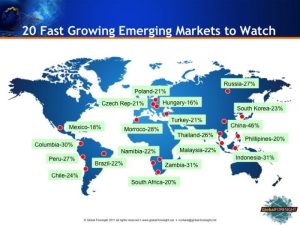
The global economic landscape is constantly shifting, with emerging market economies playing an increasingly significant role. These dynamic markets, characterized by rapid growth potential and unique challenges, offer both substantial opportunities and considerable risks for investors and businesses alike. Understanding the intricacies of these economies is crucial for navigating the complexities of the modern global marketplace. This exploration delves into the key characteristics, growth drivers, and potential pitfalls of several promising emerging market economies.
We will examine specific economies, analyzing their political and social contexts, identifying key growth sectors, and assessing the associated risks. The goal is to provide a comprehensive overview, empowering readers with the knowledge needed to make informed decisions in this dynamic investment environment.
Defining “Emerging Market Economies”
Emerging market economies represent a significant and dynamic segment of the global economy, characterized by rapid growth potential and substantial ongoing transformation. These economies are neither fully developed nor purely developing, occupying a transitional phase marked by specific economic and social features. Understanding their characteristics is crucial for investors, policymakers, and businesses navigating the complexities of international trade and finance.Emerging market economies are typically defined by a combination of factors, none of which are definitive on their own.
The classification often involves a multifaceted assessment encompassing economic indicators, social development metrics, and political stability. No single organization universally agrees on the precise criteria, leading to variations in the specific economies included in any given “emerging market” index or classification.
Criteria for Classifying Emerging Market Economies
Several organizations, including the International Monetary Fund (IMF), the World Bank, and various financial institutions, employ different methodologies to identify emerging markets. These methodologies often consider a range of factors, including Gross Domestic Product (GDP) per capita, industrialization levels, economic diversification, and the size and sophistication of the financial sector. Additionally, factors like political stability, regulatory frameworks, and infrastructure development play a significant role.
High levels of foreign investment and the presence of a growing middle class are also commonly observed characteristics. The process is dynamic, with economies moving between classifications over time based on their performance and progress.
Comparison of Emerging, Developed, and Developing Economies
Developed economies are generally characterized by high per capita incomes, advanced infrastructure, diversified economies, robust institutional frameworks, and high levels of human development. Examples include the United States, Canada, and most Western European nations. Developing economies, on the other hand, typically exhibit lower per capita incomes, limited industrialization, dependence on a few primary commodities, and weaker institutional structures. Many countries in sub-Saharan Africa fall into this category.
Emerging markets represent a middle ground, showcasing characteristics of both developed and developing economies. They demonstrate rapid growth potential but also face challenges related to infrastructure development, institutional weaknesses, and economic volatility. This transitional phase is characterized by ongoing structural changes and significant opportunities for both growth and investment.
Key Economic Indicators Across Emerging Market Classifications
The following table provides a simplified comparison of five key economic indicators across different hypothetical emerging market classifications, recognizing that the precise categorization can vary based on the source and methodology. The values are illustrative and should not be taken as precise representations of specific economies.
| Indicator | Low-Income Emerging Market | Middle-Income Emerging Market | High-Income Emerging Market | Developed Economy (for comparison) |
|---|---|---|---|---|
| GDP per capita (USD) | $2,000 | $5,000 | $15,000 | $50,000 |
| Inflation (%) | 10 | 5 | 3 | 2 |
| Foreign Direct Investment (FDI) as % of GDP | 2 | 5 | 10 | 5 |
| Ease of Doing Business Rank (World Bank) | 150 | 100 | 50 | 20 |
| Unemployment Rate (%) | 15 | 8 | 5 | 4 |
Assessing Risks and Challenges
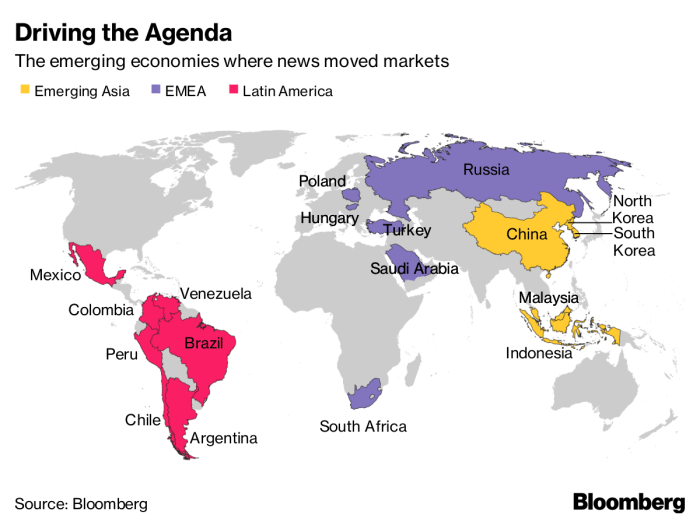
Emerging market economies, while offering significant growth potential, are inherently susceptible to a range of economic and political risks. Understanding these challenges is crucial for investors and policymakers alike, as they can significantly impact economic trajectories and overall stability. This section will analyze the major risks and challenges facing five selected emerging market economies (specific economies would need to be inserted here, for example: India, Indonesia, Brazil, Mexico, and Nigeria), exploring the interconnectedness of political instability, global economic fluctuations, and their combined effect on economic growth.Economic risks and challenges in emerging markets are multifaceted and interconnected.
These economies often grapple with vulnerabilities stemming from their stage of development, institutional weaknesses, and dependence on global commodity markets. Political instability, exacerbated by factors such as corruption, weak governance, and social unrest, further complicates the economic landscape. Global economic shocks, such as financial crises or shifts in global demand, can disproportionately impact these economies due to their often limited capacity to absorb such shocks.
Major Economic Risks and Challenges
Each of the five selected economies faces a unique set of challenges. For example, India might contend with infrastructure bottlenecks and income inequality, while Indonesia could face challenges related to its dependence on commodity exports. Brazil might struggle with political volatility and high inflation, Mexico might grapple with issues related to drug cartels and security, and Nigeria could be challenged by oil price volatility and infrastructure deficits.
A detailed analysis of these specific risks for each economy, supported by relevant data and examples from reputable sources like the World Bank or IMF, would be necessary for a comprehensive assessment.
Political Instability and Economic Growth
Political instability, manifesting in various forms including regime changes, social unrest, and policy uncertainty, significantly hinders economic growth. Investors are hesitant to commit capital in environments characterized by instability, leading to reduced investment and slower economic expansion. Furthermore, political turmoil can disrupt supply chains, damage infrastructure, and erode investor confidence, ultimately impacting macroeconomic stability. For instance, a sudden change in government policy could lead to uncertainty for businesses, affecting investment decisions and potentially leading to job losses.
Similarly, prolonged social unrest can disrupt economic activity and lead to significant losses in productivity.
Effects of Global Economic Fluctuations
Emerging market economies are particularly vulnerable to global economic fluctuations due to their integration into the global economy. Changes in global demand for their exports, shifts in capital flows, and fluctuations in commodity prices can have profound effects on their economic performance. For example, a global recession can lead to a sharp decline in export demand, impacting growth in export-oriented economies.
Similarly, a sudden withdrawal of foreign capital can trigger currency depreciation and financial instability. The 2008 global financial crisis serves as a stark reminder of the significant impact global economic shocks can have on emerging markets.
Mitigation Strategies
Addressing the risks and challenges facing emerging markets requires a multi-pronged approach. A comprehensive strategy should incorporate both short-term and long-term measures.
- Strengthening Institutions: Promoting good governance, tackling corruption, and enhancing the rule of law are crucial for creating a stable and predictable investment climate.
- Diversifying Economies: Reducing reliance on specific sectors or export markets can help mitigate the impact of global economic shocks. This could involve promoting diversification into higher-value-added industries.
- Investing in Infrastructure: Improving infrastructure, including transportation, energy, and communication networks, is essential for boosting productivity and attracting investment.
- Improving Human Capital: Investing in education and healthcare can enhance productivity and competitiveness.
- Sound Macroeconomic Management: Implementing prudent fiscal and monetary policies is crucial for maintaining macroeconomic stability and mitigating the impact of external shocks.
- Promoting Regional Cooperation: Collaboration among emerging market economies can help them address common challenges and strengthen their resilience to global economic fluctuations.
The Concept of “Emerging Market”
The term “emerging market” is a relatively recent construct in the world of finance and economics, evolving significantly over time. Its origins lie in the post-World War II era, reflecting a changing global economic landscape and the rise of newly independent nations seeking economic development. Initially, the focus was largely on the potential for growth in these countries, often characterized by their transition from primarily agrarian economies to more industrialized ones.The definition and classification of emerging markets have been fluid and often contested.
Early classifications relied heavily on indicators such as GDP per capita, industrialization levels, and trade openness. However, these simplistic metrics proved inadequate to capture the nuances of diverse national economies. Over time, more sophisticated methodologies emerged, incorporating factors like financial market development, institutional quality, and political stability. These more nuanced approaches aim to provide a more comprehensive and accurate assessment of a country’s economic maturity and investment potential.
Evolution of Emerging Market Classifications
Several prominent organizations, including the International Monetary Fund (IMF), the World Bank, and various private index providers like MSCI and FTSE, have developed their own methodologies for classifying emerging markets. These classifications are not always perfectly aligned, reflecting differing criteria and weighting schemes. For example, some indices emphasize market capitalization and liquidity, while others place greater weight on macroeconomic indicators or governance factors.
These differences can lead to discrepancies in which countries are included in various emerging market indices, impacting investment flows and policy decisions. This evolution reflects a growing understanding of the complexities inherent in categorizing economies based on their developmental stage.
Diverse Perspectives on “Emerging Market” Definition
Different perspectives exist on what constitutes an “emerging market.” Some emphasize the rapid growth potential and opportunities for investors, focusing on dynamic economies with high rates of GDP growth and expanding consumer markets. Others prioritize factors like institutional strength, political stability, and regulatory frameworks, acknowledging that these factors are crucial for long-term sustainable development and attracting foreign investment. A third perspective might focus on the integration of these economies into the global financial system, highlighting the increasing interconnectedness of emerging markets with developed economies through trade, capital flows, and technological exchange.
These different lenses highlight the multi-faceted nature of the concept, making it challenging to develop a universally accepted definition.
Impact of Global Events on Emerging Market Perception
Global events significantly influence the perception and classification of emerging markets. For example, the 1997 Asian financial crisis dramatically altered the understanding of risk associated with these markets, leading to tighter lending standards and greater scrutiny of macroeconomic fundamentals. Similarly, the 2008 global financial crisis and the subsequent Eurozone debt crisis highlighted the interconnectedness of global financial markets and the vulnerability of emerging economies to external shocks.
More recently, the COVID-19 pandemic and the ongoing war in Ukraine have further underscored these vulnerabilities, demonstrating the significant impact of global events on investor sentiment and economic performance in emerging markets. These crises often lead to revisions in classification methodologies and a greater focus on resilience and risk management in investment strategies.
Illustrative Examples
This section delves into the economic transformation of one specific emerging market economy, examining a period of significant change. We will analyze the key contributing factors, and assess the resulting social and environmental impacts. The chosen example provides a valuable case study for understanding the complexities of economic development in emerging markets.
China’s Economic Transformation: 1978-Present
China’s economic transformation since the late 1970s represents one of the most dramatic shifts in global economic history. Following decades of centrally planned socialism, Deng Xiaoping’s leadership initiated a series of reforms that fundamentally reshaped the nation’s economy. This period saw a transition from a largely agrarian society to a global manufacturing powerhouse.The key factors driving this transformation were multifaceted.
The introduction of market-oriented reforms, including the establishment of Special Economic Zones (SEZs), played a crucial role. These zones offered incentives to foreign investment and fostered the growth of export-oriented industries. Simultaneously, significant investments in infrastructure, education, and technology facilitated industrial expansion and increased productivity.
“The opening up of China was not a smooth process. There were many challenges and setbacks along the way. However, the overall direction was clear: to integrate China into the global economy.”
This quote encapsulates the inherent complexities and risks involved in such a large-scale economic shift. The reforms also led to significant improvements in living standards for a large segment of the population, lifting millions out of poverty. However, this rapid growth came at a cost. Environmental degradation, particularly air and water pollution, became a serious concern in many rapidly industrializing areas.
Furthermore, the widening income gap between urban and rural areas, and between different regions, remains a significant social challenge.
“While China’s economic growth has been remarkable, it has also created new challenges, including environmental pollution and income inequality.”
This rapid industrialization also resulted in significant social changes. Millions migrated from rural areas to urban centers in search of employment, leading to rapid urbanization and the development of sprawling megacities. This mass migration also placed a strain on urban infrastructure and social services. The transformation also had profound impacts on the cultural landscape, with traditional ways of life adapting to the pressures of modernization and globalization.
The social and environmental consequences of China’s economic transformation continue to be debated and addressed through various policy initiatives.
In conclusion, while investing in emerging markets presents inherent risks, the potential for significant returns remains compelling. Careful consideration of political stability, economic diversification, and potential global economic shocks is paramount. By understanding the unique characteristics and challenges of each market, investors can develop strategies to mitigate risks and capitalize on the substantial growth opportunities presented by these dynamic economies.
Continued monitoring and adaptation to evolving circumstances are essential for success in this dynamic and ever-changing arena.
Essential FAQs
What are the main differences between emerging and developed markets?
Developed markets generally have higher per capita incomes, more diversified economies, robust institutions, and lower levels of political risk compared to emerging markets, which are characterized by faster growth, but also greater volatility and risk.
How can I mitigate the risks associated with investing in emerging markets?
Diversification across different emerging markets and asset classes, thorough due diligence, and a long-term investment horizon are crucial risk mitigation strategies. Professional financial advice is also highly recommended.
What are some common indicators used to assess the health of an emerging market economy?
Key indicators include GDP growth rate, inflation rate, foreign exchange reserves, current account balance, and debt-to-GDP ratio. Political stability and social indicators also play a vital role.
What are the ethical considerations when investing in emerging markets?
Ethical considerations include ensuring investments align with sustainable development goals, respecting local communities and cultures, and avoiding contributing to environmental damage or exploitation.